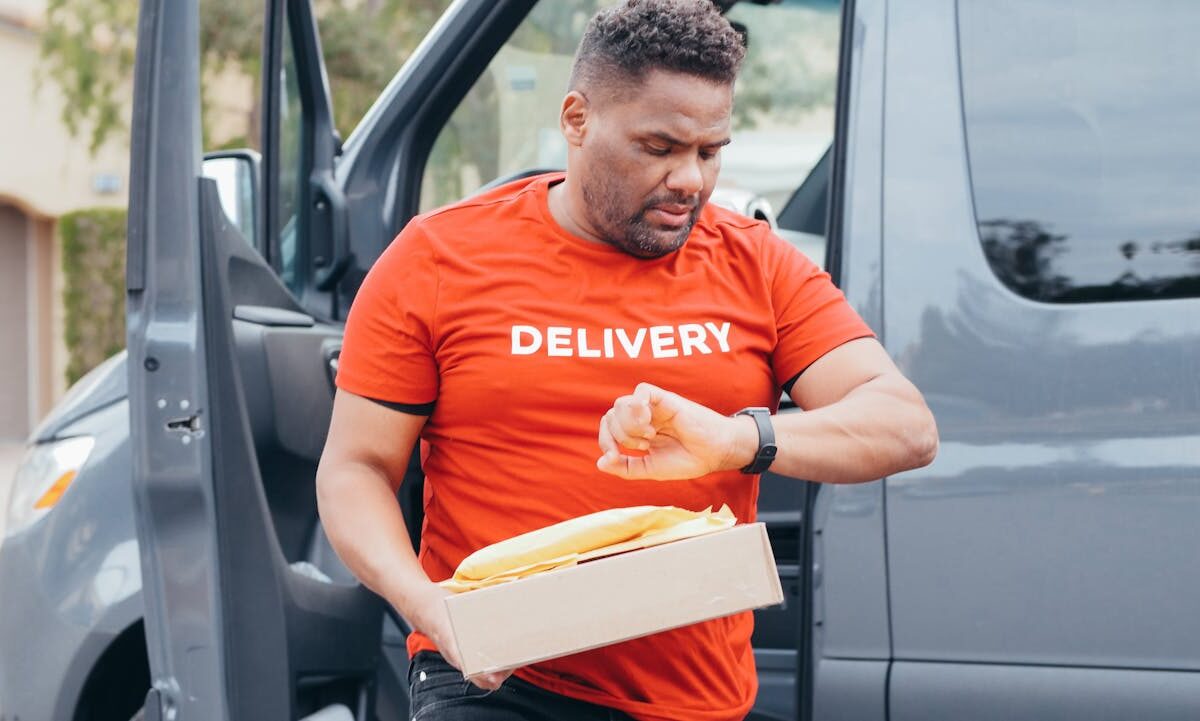
The last mile problem hits hardest when order volume spikes and delivery promises tighten. Costs climb through reattempts, overtime, and exception handling, while trust drops as ETAs slip and updates arrive late.
What once looked like a routing issue is now a systems challenge spanning capacity, partner handoffs, doorstep execution, and customer communication. Many enterprises are redesigning the operating model behind delivery, then backing it with last mile delivery software that keeps decisions consistent under peak pressure.
The last mile problem becomes manageable when planning and execution share one truth and every handoff preserves context for the next team. Last mile delivery tracking keeps the status visible from the hub to the doorstep. Let’s learn how teams hold service steady and costs predictable.
What the Last Mile Problem Looks Like at Scale
At high volume, the last mile problem is less about the shortest path and more about compounding constraints that break plans and slow recovery.
- Time Windows Stack up Fast
Narrow delivery slots reduce routing flexibility, so one delay can cascade into multiple missed windows across the route.
- Access Rules Change By Address
Gated entries, apartment protocols, and customer availability vary by neighborhood, creating unpredictable stops and a higher first-attempt failure risk.
- Service Time Volatility Disrupts Routes
Parking friction, security checks, and product handling shift stop duration cause planned ETAs to drift early in the shift.
- Multi-Carrier Execution Fragments Visibility
Different partners use different milestones and scan disciplines, which creates inconsistent tracking signals and delayed issue detection.
- Handoffs Lose Context and Create Rework
Missing notes, incorrect loadouts, and unclear exceptions force manual calls, repeated attempts, and late reroutes that inflate cost.
- Exceptions Escalate Too Late
When exception signals arrive late, dispatch reacts after service has already broken, increasing overtime, churn, and customer complaints.
Shift 1: Rethinking The Last Mile Problem Through Delivery Orchestration
One major shift is moving from standalone routing to delivery orchestration. Orchestration coordinates decisions across owned fleets, outsourced carriers, and customer promise requirements. Instead of treating planning, dispatch, tracking, and exceptions as separate tools, orchestration unifies them into a single operational loop.
This matters because the last mile problem often comes from inconsistent decision logic across teams. One group optimizes cost, another protects service, and a third handles customers with incomplete context. A control tower aligns these priorities by combining proactive monitoring, exception management, and collaboration workflows that trigger recovery actions earlier.
What orchestration changes in practice:
- A single milestone language across carriers, zones, and service tiers
- Control-tower ownership for exceptions, detours, and long halts
- Chain-of-custody tracking that flags load errors before they create reattempt loops
- Structured loadout sequencing and dock scheduling that improve departure discipline
- Pre-sort and pre-load by SLA, vehicle, and zone to reduce dispatch chaos
Shift 2: Solving The Last Mile Problem By Fixing Blind Handoffs
Many leaders now treat blind handoffs as a hidden engine of the last mile problem. Handoffs happen everywhere: consignment creation, label generation, dispatch manifests, carrier pickup, driver execution, proof capture, and then billing. If any handoff loses context, the next team compensates with manual rework and late escalations.
The rethink is straightforward: handoffs must become structured and machine-readable. That means consistent reason codes, standardized event timelines, and proof tied to verifiable events. When last mile delivery tracking is connected to workflow, teams reduce latency between field reality and system truth, which improves ETA credibility and exception response speed.
This is also where smart audit concepts matter in practice:
- Smart proof checks for PoD and signatures using OTP or image recognition
- Suspicious PoD or signature patterns flagged for driver or technician debriefing
- Invoice reconciliation and dispute resolution tied to verified delivery events
- Cleaner evidence trails that reduce back-and-forth during claims and billing cycles
Shift 3: Reducing The Last Mile Problem in Dense Markets With Micro-infrastructure
In dense markets, the last mile problem is constrained by curb space, congestion, and repeated doorstep failures. Businesses are adding micro-infrastructure such as pickup points, parcel lockers, and PUDO networks. PUDO refers to designated pick-up and drop-off locations that customers can use for collection and returns, reducing failed attempts and doorstep friction.
These models create operational flexibility:
- Alternate delivery points that improve first-attempt completion
- Better density through consolidation closer to demand
- Reduced dwell time by shifting handoffs away from curb-edge constraints
- Smoother reverse logistics through structured drop-off flows
Micro-infrastructure also connects cleanly with territory planning and hub network optimization, since it changes how coverage is designed and where volume is injected.
Shift 4: Using AI For Prediction and Prevention, Not Reporting
Another rethink is how AI is used. The older model focused on reporting after the day ended. The newer model prioritizes prediction and prevention, so teams act before a delivery promise breaks. That includes predictive ETAs, delay risk scoring, and automated recovery actions through a control tower workflow.
AI agents are also being applied as role-based assistants:
- Dispatchers get route validator and modifier support for quick replans
- Network planners get demand forecasting, capacity planning, and market design inputs
- Finance and billing teams get data validator, transformer, and reconciliator workflows
- Customer support teams get consumer assistant flows that reduce WISMO pressure
This reduces the last mile problem by standardizing intervention logic under volatility, instead of relying on tribal knowledge during peak weeks.
Shift 5: Treating Cost Governance as a Real-time Decision Layer
At scale, the last mile problem is amplified when cost controls live outside execution. Businesses are bringing cost governance into routing and allocation decisions through rate management, contract repositories, and automated reconciliation.
Two approaches show up frequently in mature networks:
- Rate-based routing with real-time cost comparison across private fleets and outsourced options
- Smart carrier allocation using rates, lead times, and package rules like weight, dimensions, and ship-together logic
This is also where zone skipping and parcel consolidation reduce cost-to-serve. Zone skipping consolidates shipments headed to the same region and moves them closer to the destination before local injection, reducing expensive zone hops.
Shift 6: Preventing The Last Mile Problem With Better Capacity Planning
Many delivery failures start weeks earlier as planning gaps, not driver errors. High-volume leaders now treat capacity planning as a first-class capability:
- Capacity forecasting utility aligned to seasonal peaks and promotion calendars
- Territory planning with dynamic boundaries that adapt as demand shifts
- Density analysis and demand smoothing to balance workload across days
- Hub network optimization to improve coverage and reduce linehaul-to-last-mile friction
- What-if simulations that model the cost per delivery under different demand scenarios
This planning maturity makes execution more stable because dispatch starts from feasible assumptions, not last quarter’s averages.
What Logistics Leaders Should Do Next
To reduce the last mile problem at scale, build a repeatable operating rhythm:
- Standardize milestones, exception codes, and ownership across partners
- Connect consignment management, labeling, dispatch, and order-to-door visibility into one workflow
- Improve delivery slot selection through real-time slot availability tied to true capacity
- Invest in last mile delivery tracking that keeps ETAs credible and exceptions actionable end-to-end
- Expand PUDO options in dense zones where doorstep delivery fails for structural reasons
- Use zone skipping and parcel consolidation where volume supports regional injection strategies
Build a Scalable Operating Model to Beat The Last Mile Problem
Winning teams reduce variability, tighten handoffs, and standardize decisions, so execution stays stable when demand spikes and constraints multiply across dense markets. They treat orchestration, predictive ETAs, and governed exception playbooks as core operating design, then reinforce those choices with scalable integrations and proof discipline.
Micro-infrastructure like pickup points and microhubs adds flexibility in neighborhoods where doorstep delivery fails for structural reasons, improving density and lowering repeat effort. With technology partners such as FarEye, teams can modernize faster while keeping workflows, accountability, and data quality aligned to measurable outcomes.
Track carrier events daily and review performance weekly to lock gains. Set a 90-day plan to standardize milestones, digitize handoffs, improve prediction quality, and tighten recovery actions across carriers and zones.