Satya
Satya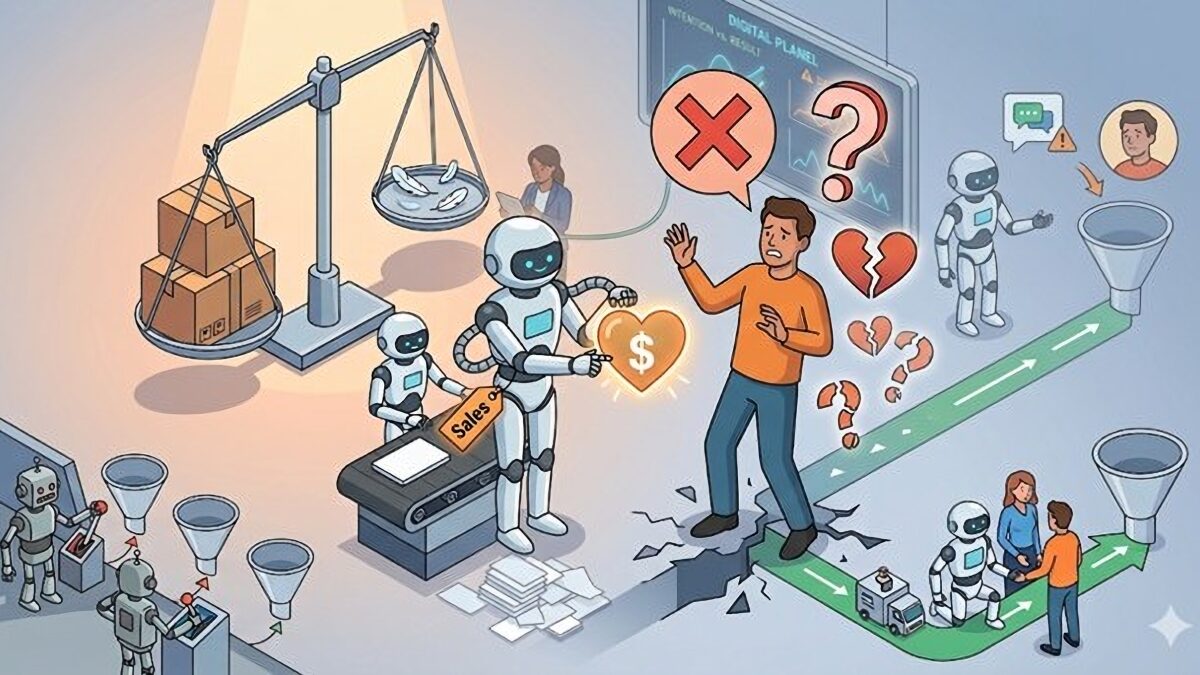
Efficiency is the most dangerous drug in business. Every software vendor pitches marketing automation as the ultimate time-saver, promising that you can “set it and forget it” while revenue rolls in. But nobody warns you about the reputational damage that occurs when a machine executes a bad instruction at scale.
We have all experienced the “uncanny valley” of bad automation. It’s the discount email you receive five minutes after angrily contacting support about a broken product. It’s the “We miss you” message sent to a customer who bought yesterday. In these moments, technology doesn’t help, it insults. When automation operates without context, it signals to your customers that you care more about your process than their experience. The goal of automation should never be to replace thinking; it should be to amplify a strategy that already works.
The erosion of brand trust
Trust takes years to build and seconds to break. When a customer realizes they are being tricked by a script, the psychological contract is severed. They stop viewing your brand as a group of humans solving a problem and start viewing it as a faceless entity trying to extract cash.
This erosion is often silent. Customers don’t always unsubscribe or complain; they simply tune out. They develop “automation blindness,” ignoring your emails and notifications because they have learned that your communication is generic, irrelevant, and likely automated by a robot that doesn’t know who they are.
The fake personalization trap
Using a {First_Name} token is not personalization; it is a parlor trick that stopped working a decade ago. Nothing destroys credibility faster than a “Re: Our meeting” subject line when no meeting ever occurred, or a “Hey [Name]” greeting that feels synthetically enthusiastic. This lazy approach insults the intelligence of the modern buyer.
True personalization is about behavior, not identity. It’s about being present where the customer actually is. For example, if a user engages with your brand visuals, leveraging an ai agent tool to deliver a relevant lookbook or answer a specific question adds value. This works because it is timely and contextual, unlike a generic email blast that pretends to be a personal letter from the CEO.
Context blindness (The support paradox)
The single biggest failure point in automation is the lack of communication between marketing tools and support desks. Marketing workflows are often blind to the customer’s current reality. They keep selling, cheering, and nudging, unaware that the customer is currently furious about a billing error or a service outage.
This “deafness” creates a toxic customer experience. If a client has an open ticket, your marketing needs to shut up. Your system requires suppression logic that overrides sales goals. A smart WhatsApp AI can recognize a support query and immediately pause promotional messages, routing the user to a human agent instead. Prioritizing resolution over promotion is the only way to save the relationship.
This is where an AI Agent becomes essential, making real-time decisions based on customer context rather than blindly following predefined workflows.
Creating operational debt
While the external damage to the brand is severe, the internal damage is often just as costly. Bad automation creates “operational debt”—a messy tangle of rules, tags, and workflows that slows down your team and creates confusion.
The “set and forget” rot
The phrase “set it and forget it” is a lie. Workflows built three years ago are likely still running in the background of your business today, referencing pricing that no longer exists, linking to dead pages, or pushing products you have pivoted away from.
These “Zombie Workflows” run silently, confusing leads and making your brand look obsolete. A lead might receive a welcome sequence that contradicts your current sales pitch, creating friction that your sales team has to manually explain away. Automation is not a passive asset; it is machinery that requires regular maintenance. Every workflow needs an expiration date and a quarterly audit to ensure it still aligns with the company’s current reality.
Data pollution and false positives
Many businesses score leads based on vanity metrics like email opens or link clicks. This often floods the CRM with “Hot Leads” that are actually just bots scanning emails for malware, or existing customers clicking on a newsletter.
When the sales team spends a week calling these “high-score” leads only to find they have zero intent to buy, they lose faith in the system. They stop trusting the marketing automation score and go back to cold calling or relying on gut instinct. To fix this, you must stop scoring clicks and start scoring high-intent actions, like visiting a pricing page or requesting a demo. Quality must always trumpet volume.
The best automation is invisible
Technology is an accelerator. It accelerates success, but it also accelerates failure. If your underlying process is flawed, automation will simply help you annoy more people, faster.
Don’t build new workflows this week. Instead, audit the old ones. Look for the leaks where your automation is insulting your customers or confusing your team. If the customer can feel the gears turning, you have failed. The most effective automation is the kind that feels so human, nobody knows it’s there.